

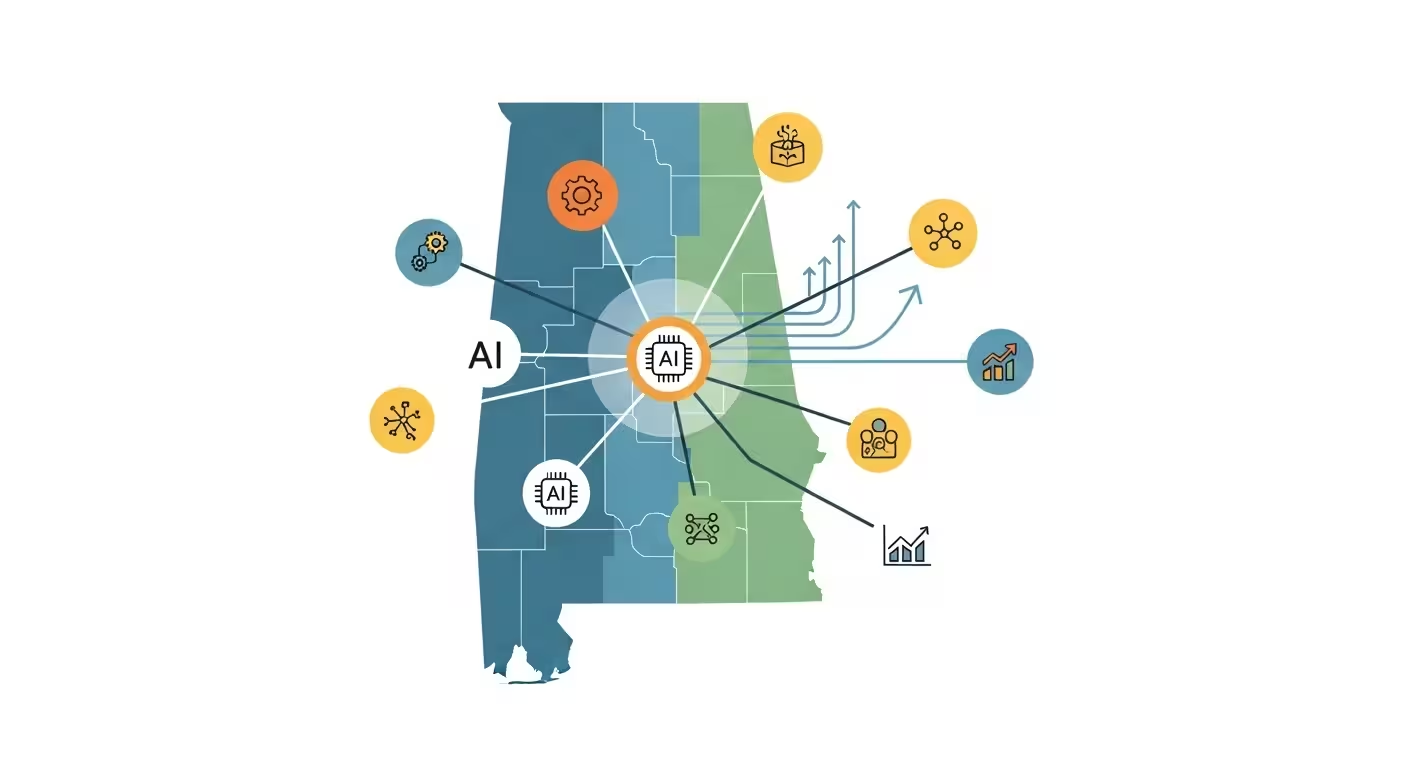
Alabama saw a 57% jump in job postings for AI-related roles. The large employers are moving. Most small businesses are still wondering where to begin. This is where to begin.
Let’s be honest about something. If you own or run a small or mid-size business in Alabama and you’ve been following the AI conversation, you’ve probably felt one of two things. Either mild anxiety that everyone else is further along than you are. Or quiet scepticism that most of this doesn’t actually apply to a business like yours.
Both reactions are understandable. And both are slightly off target.
The anxiety isn’t necessary because you don’t need to be doing everything right now. The scepticism isn’t warranted because AI tools have moved well past the phase of being only relevant to tech companies or large enterprises. There are practical, affordable, low-risk ways for Alabama businesses to start using AI that produce real results in ordinary business workflows. You don’t need a data science team or a six-figure technology budget to get there.
What you do need is a clear starting point. Here’s one.
What’s actually happening with AI in the Alabama business community.
Alabama’s tech sector has been posting strong numbers on AI-related hiring for a couple of years now. The state saw a 57% increase in job postings related to AI and machine learning, driven heavily by the defence and aerospace corridor in Huntsville. Palo Alto Networks just partnered with UAH’s Invention to Innovation Center to expand AI and cybersecurity development across North Alabama. The Alabama SBDC is now running practical AI sessions specifically for small business owners.
That last one is worth paying attention to. When the Small Business Development Center starts running AI training sessions, it’s a signal that adoption has moved past the experimental phase for small businesses. It’s becoming expected.
Meanwhile, national data backs that up. Research from Intuit found that 89% of small businesses are already using AI tools in some form, mostly for routine task automation and faster decision-making. The US Chamber of Commerce predicts that adoption among small businesses will accelerate significantly through 2026, particularly in marketing, HR, customer service, and operations.
The gap isn’t between businesses that know about AI and businesses that don’t anymore. It’s between businesses that are using it deliberately, with a clear sense of what they’re trying to achieve, and businesses that are using it casually without much structure or measurement. The second group is leaving results on the table.
89% of small businesses are already using some form of AI. The question for most Alabama businesses isn’t whether to start. It’s how to move from casual use to intentional adoption that actually changes how the business operates.
The honest reason most small businesses stall at step one.
Talk to small business owners in Birmingham, Huntsville, or Montgomery about AI and you’ll hear the same things. They’ve used ChatGPT a few times. They find it useful for writing. Sometimes they use it to summarise things. But they haven’t really integrated it into how the business runs, and they’re not sure how to get from here to there.
The reason this happens is consistent across businesses of every size, and it’s worth naming directly. Most businesses spend the bulk of their AI budget, whether that’s money or time, on tools. They buy subscriptions, try platforms, and set up integrations. And then the tools don’t get used as much as expected, because the people using them weren’t given clear guidance on what problem the tool was supposed to solve or how to measure whether it was working.
This isn’t a technology problem. It’s a clarity problem. The businesses seeing real returns from AI in 2026 are the ones that started with a specific workflow they wanted to improve, chose a tool to address that workflow, and measured the result before moving on. Not the ones that bought the most impressive software and hoped the team would figure it out.
A practical framework for Alabama businesses starting out.
You don’t need a roadmap with twenty steps. Here’s a four-part process that works for businesses at any size and any current level of AI familiarity.
Part 1: Pick one workflow, not one tool.
The instinct is to start with a tool. ChatGPT, Copilot, something you’ve seen advertised. The better starting point is a workflow. What does your team do repeatedly that takes more time than it should? What task produces the same output every week from slightly different inputs?
Good candidates for a first AI workflow in an Alabama small business:
- Drafting client communications, proposals, and follow-up emails from notes or call summaries.
- Summarising long documents, contracts, or reports into actionable points.
- Building first drafts of social media content, job postings, or internal documentation.
- Processing and categorising customer feedback or support requests.
- Generating reports or summaries from data that currently requires manual formatting.
Pick one. Not several. One workflow, one team, one clear expected output.
Part 2: Choose the simplest tool that does the job.
You don’t need the most powerful or most expensive tool for a first AI workflow. You need the one your team will actually use. Microsoft Copilot is already embedded in Microsoft 365, which many Alabama businesses are already paying for. Google Workspace has similar AI features built in. For standalone use cases, a well-structured prompt in a general AI tool is often enough to produce the output you need.
Complexity is the enemy of adoption at the early stage. If your team has to learn a new platform, new integrations, and new workflows simultaneously, adoption stalls. Start with what’s already in the tools they use every day.
Part 3: Measure for 90 days.
Before you expand to a second workflow or a different tool, spend 90 days with the first one. Measure two things: time saved per week on the target workflow, and quality of the output compared to the manual process. That’s it. You don’t need a complex ROI model.
If the workflow is saving time and the output quality is acceptable, you have evidence that AI adoption is working in your business. That evidence is what justifies the next step, internally and to your team. If it’s not working, you find out cheaply before you’ve invested more broadly.
Part 4: Build a simple policy before you scale.
This is the step that most small businesses skip and then regret. As soon as your team starts using AI tools, questions come up. Can we put client data into these tools? What do we do with the output? Who reviews it before it goes out? What tools are approved and which aren’t?
Alabama has no single comprehensive AI statute, but existing consumer protection, employment, and data security laws apply to how AI is used in business contexts. You don’t need a legal document. You need a one-page internal policy that answers: what tools are approved, what data can go in, who reviews AI-generated output before it’s used, and how you handle a situation where something goes wrong.
A 30-minute conversation with your IT partner to draft that policy is worth doing before you have a situation that forces the issue.
The businesses seeing real ROI from AI in 2026 started with one workflow, measured it honestly, and built from evidence rather than enthusiasm. That discipline is the whole thing. The tools are mostly secondary.
What Alabama’s AI environment means specifically for your competitive position.
Here’s a practical reality about operating in Alabama’s current business environment. The state is attracting large employers with sophisticated technology operations. Defence contractors, pharmaceutical companies, data centre operators, aerospace firms. These companies work with local vendors.
When those companies evaluate local vendors, they’re increasingly asking questions about technology capability. Not just cybersecurity and data handling, though those matter too. They’re asking whether a vendor can operate at their speed, produce outputs at their quality level, and integrate with their workflows.
A small Alabama business that has built deliberate AI adoption into its operations, that can draft proposals faster, respond to client requests more quickly, and produce cleaner documentation, is a more attractive vendor than one operating entirely on manual processes. That’s not hypothetical. It’s showing up in how enterprise companies evaluate their local partners.
Getting started with AI isn’t just about internal efficiency. In the current Alabama business environment, it’s increasingly about whether you look like a business that large employers and clients want to work with.
The short version.
You don’t need to catch up to anyone. You don’t need to buy more software or hire a data scientist. You need to pick one workflow that takes more time than it should, run an AI tool through it for 90 days, measure what happens, and then decide what comes next based on actual results rather than hype or anxiety.
That’s step one. It’s achievable this week. And it’s how every business that’s now doing this well actually started.
If you want help identifying where AI fits in your specific business workflows, or you want to understand what tools make sense for your team’s situation, that’s exactly the kind of conversation we have with Alabama businesses every day.
About Kindred Technology Group
Kindred Technology Group, LLC is an Alabama-based technology partner helping businesses across the state build the systems, security practices, and workflows they need to grow with confidence. We understand the Alabama business environment because we work in it every day.
Ready to have a practical conversation about AI and technology for your business? Reach out to Kindred Technology Group.
Kindred Technology Group, LLC. Alabama-based technology solutions for growing businesses.